

09 Sep Industrial automation solution with motion controller for smart manufacturing
Industrial Automation Solution & Motion Controller: Smarter Control for Modern Industry
Modern manufacturing depends on accuracy, consistency, productivity, and reliable machine performance. An industrial automation solution can help bring these priorities together. As production systems become more connected and demanding, businesses need technologies that automate repetitive operations while maintaining precise control.
An industrial automation solution brings together controllers, drives, sensors, HMIs, instrumentation, communication systems, and other equipment to manage industrial processes efficiently. At the same time, a motion controller coordinates machine movement where speed, position, acceleration, synchronization, and repeatability are critical. DS Automation & Controls provides industrial automation and control products for diverse industrial requirements.
What Is an Industrial Automation Solution?
An industrial automation solution is an integrated combination of hardware, software, control systems, and engineering practices used to automate industrial processes. Instead of relying entirely on manual operation, machines can perform programmed tasks with limited human intervention. Depending on the application, the system may include PLCs, HMIs, drives, sensors, actuators, instrumentation, motion equipment, and industrial communication networks.
The objective is not simply to reduce manual work. A properly planned system can improve production efficiency, process consistency, machine monitoring, diagnostics, safety, and energy management. It can also provide a scalable foundation for future upgrades as production requirements change.
Why Industrial Automation Matters
Manufacturers need consistent quality while managing labour, energy, maintenance, and production costs. Automation can make repetitive operations consistent and provide useful process information.
Key advantages include:
- Improved production efficiency and capacity
- Better process accuracy and repeatability
- Reduced unnecessary downtime
- Improved monitoring and diagnostics
- Safer operation of selected machine functions
- More efficient use of energy and resources
A well-engineered industrial automation solution can connect these functions into a coordinated control architecture rather than treating each machine component as an isolated device.
What Is a Motion Controller?
A motion controller is a device or control system responsible for managing machine movement. A second motion controller may be used when an application requires additional coordinated axes. It can coordinate position, velocity, acceleration, and synchronization while communicating with drives, motors, sensors, and other machine components.
For example, a packaging machine may need to move a product to a precise position, synchronize a cutting mechanism, complete the operation, and then prepare for the next cycle. A motion controller can manage the required movement sequence and send commands to the drive and motor system.
Motion control is particularly useful in machines where accurate and coordinated movement is essential. Depending on the application, it may support multiple axes, servo systems, programmable movement profiles, and feedback-based control.
How Automation and Motion Control Work Together
An industrial automation solution and a motion controller are complementary technologies. A PLC or broader control platform can manage machine sequences, inputs, outputs, alarms, communication, and process logic, while dedicated motion control handles sophisticated movement requirements.
Consider a production line that detects a product with a sensor, starts a conveyor, positions the product, synchronizes another mechanism, performs cutting or sealing, and monitors machine status. These tasks can require PLC control, drives, sensors, HMI, communication, and motion control working together. This integration can improve machine coordination and make complex production processes easier to monitor.
Applications Across Industries
Motion-control technology is valuable wherever machines require precise and repeatable movement. Applications identified include textile and non-woven manufacturing, pulp and paper, film and plastics or foil converting, metals, sugar mills, and tire and rubber manufacturing.
In textile machinery, coordinated movement supports consistent speed and operation. Film and plastic machinery such as extruders, laminators, slitters, and rewinders can require synchronized movement. Paper machinery may use multiple drives, while metal-processing equipment can involve rollers, grinders, and cut-to-length systems. Tire and rubber machinery may also depend on controlled speeds and repeatable sequences.
Benefits of Using a Motion Controller
A suitable motion controller can offer several practical benefits when correctly selected and engineered:
- High positioning precision
- Better synchronization between machine sections
- Consistent movement repeatability
- Flexible programming for different sequences
- Smooth and optimized motion profiles
- Integration with PLCs, HMIs, drives, sensors, and communication networks
Choosing the Right System
Every industrial application has different requirements, so product selection should begin with the process rather than an individual component.
Important considerations include production volume, machine cycle time, process sequence, number of controlled axes, required accuracy, operating speed, acceleration, deceleration, communication requirements, and future expansion.
Machine architecture should also be reviewed to determine whether the project requires PLCs, servo systems, VFDs, instrumentation, HMI, SCADA, motion control, or a combination. Product compatibility and technical support are equally important.
An industrial automation solution should be selected according to actual operating conditions and long-term objectives. Engineering, commissioning, troubleshooting, maintenance, and support can be as important as initial equipment selection.

Why Choose DS Automation & Controls?
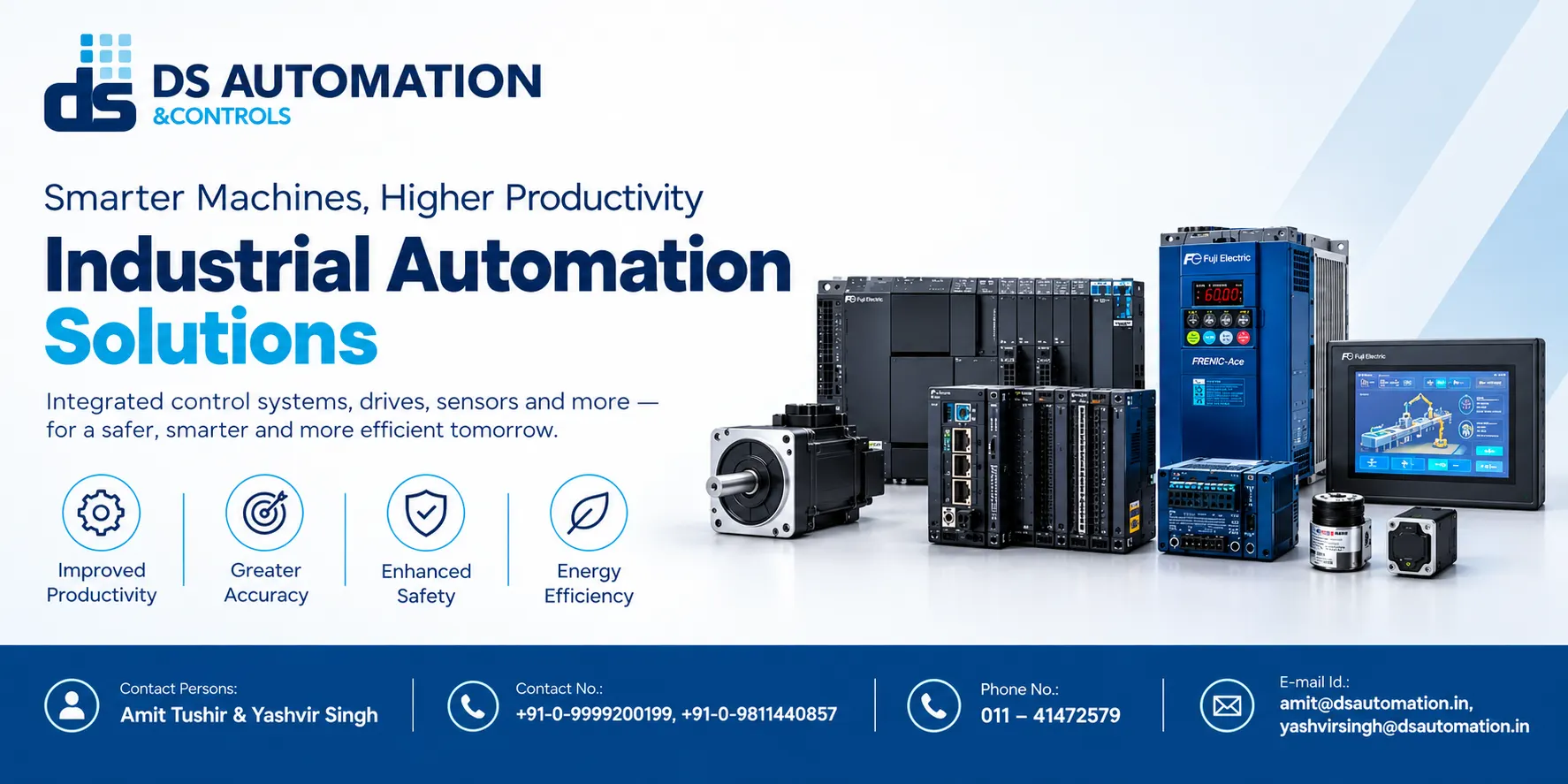
DS Automation & Controls offers products and technologies covering industrial automation, motion control, drives, instrumentation, and electrical distribution. Its published portfolio includes Fuji Electric drives, PLCs, motion controllers, servo systems, instrumentation products, and other industrial-control equipment.
For businesses evaluating an industrial automation solution, working with an experienced supplier can simplify product selection and system planning. This approach also helps align equipment with the wider control architecture.
The right approach considers the machine, process, environment, performance targets, and future requirements together.
The Future of Industrial Automation
Industrial automation is moving toward more connected, flexible, and intelligent production environments. Industrial networking, smart sensors, advanced motion control, machine diagnostics, data monitoring, robotics, and digital manufacturing are increasingly becoming part of modern operations.
Modern systems can provide better information, support faster decisions, simplify maintenance, and contribute to continuous improvement. As requirements evolve, an industrial automation solution can provide a scalable foundation for future upgrades.
Conclusion
The combination of an industrial automation solution and a motion controller can provide a strong foundation for modern manufacturing and machine applications. Automation supports productivity, consistency, monitoring, and operational efficiency, while motion control provides the precision and coordination required for demanding movement.
DS Automation & Controls offers products for industrial control, drives, motion, instrumentation, and electrical applications. Selecting equipment according to process requirements and integrating the different technologies properly can help manufacturers build productive, accurate, flexible, and future-ready operations.

No Comments