


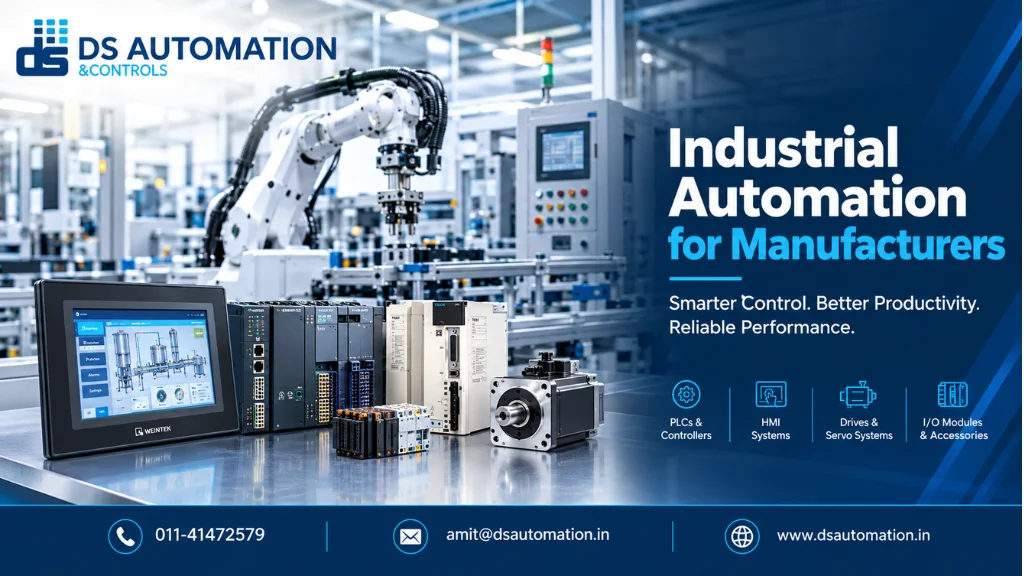
14 Oct Industrial Automation for Manufacturers: Improving Productivity and Efficiency
Introduction
Industrial automation for manufacturers helps businesses improve productivity, maintain consistent quality, and manage repetitive production operations. From assembly lines and material handling to machine control and inspection, automation can streamline workflows and reduce unnecessary manual intervention.
As production requirements grow, manufacturers need reliable systems that support operational efficiency and better process control.
DS Automation offers industrial automation and electrical control products that businesses can explore when evaluating their machinery and production requirements.
What Is Industrial Automation?
Industrial automation uses control systems, machines, sensors, drives, and software to operate manufacturing processes with limited manual intervention. These technologies can control machine movements, regulate operating parameters, coordinate equipment, and alert operators when conditions change.
Automation does not always require replacing an entire production line. Businesses can begin by upgrading motor controls, automating repetitive tasks, or introducing monitoring systems to existing machinery. The right approach depends on production volume, equipment condition, available space, and operational objectives.
Industrial automation for manufacturers supports both small production facilities and large industrial plants. A properly planned system can improve consistency while allowing employees to focus on supervision, maintenance, and higher-value activities.
Why Is Industrial Automation Important for Manufacturers?
Manufacturers face challenges such as changing demand, production delays, rising operating costs, and strict quality expectations. Automation can address some of these challenges by making machine operations more consistent and easier to monitor.
Industrial automation for manufacturers can improve production cycles, reduce manual handling in suitable applications, and provide better visibility into equipment performance. Automated alarms can also help teams identify unusual conditions before they develop into larger operational problems.
Key benefits include:
- Improved productivity: Automated equipment performs programmed tasks consistently.
- Better process control: Controllers maintain specified settings and sequences.
- Consistent quality: Sensors and inspection systems help identify process variations.
- Reduced downtime: Fault alerts support faster troubleshooting.
- Energy management: Suitable motor drives adjust speed according to process demand.
- Workplace safety: Automation can reduce exposure to selected hazardous or repetitive tasks.
Results depend on appropriate system design, correct installation, operator training, and regular maintenance.
Common Technologies Used in Industrial Automation
Manufacturing facilities combine different technologies according to their operational requirements. Programmable logic controllers (PLCs) manage machine logic and sequences, while human-machine interfaces (HMIs) allow operators to monitor equipment and respond to alarms.
Variable frequency drives (VFDs) control AC motor speed, while servo drives and motors provide precise motion and positioning. Supervisory control and data acquisition (SCADA) systems support central monitoring and process-data collection. Sensors and industrial instrumentation measure variables such as temperature, pressure, flow, and level.
The following table summarises commonly used technologies and their applications.
| Technology | Main Function | Manufacturing Application |
|---|---|---|
| PLC | Executes programmed machine logic | Assembly sequences and conveyor control |
| HMI | Displays operating information | Machine settings and alarms |
| VFD | Adjusts AC motor speed | Pumps, fans, and conveyors |
| Servo Systems | Provides controlled motion | Packaging and positioning |
| SCADA | Supervises processes and collects data | Centralised production monitoring |
| Sensors and Instrumentation | Measures operating conditions | Temperature and pressure monitoring |
| Electrical Protection | Helps protect electrical circuits | Control panels and power distribution |
Components should be compatible with the machinery, operating environment, communication requirements, and applicable safety standards.

Applications Across Manufacturing Industries
Industrial automation for manufacturers has applications across multiple sectors. Packaging facilities can automate filling, sealing, conveying, and machine synchronisation. Food-processing plants may use automation for mixing, temperature monitoring, and packaging operations.
Pharmaceutical facilities can benefit from controlled production sequences and equipment monitoring. Textile manufacturers may automate machine sequencing and motor control, while plastics and rubber plants can use automation for moulding, extrusion, and temperature regulation.
Paper, printing, and general engineering facilities may also benefit from coordinated drives, assembly automation, material handling, and machine inspection.
Before implementation, businesses should review production targets, existing equipment, product specifications, and the consequences of interruptions. Testing a smaller automation project can help determine whether a solution meets operational requirements before expanding it across the facility.
How Automation Improves Production Efficiency
A well–designed system helps equipment perform repeated operations in a predictable sequence. Sensors can monitor selected parameters and notify operators when readings move outside configured limits. Suitable drive control can also adjust motor output to match demand in applications where variable speed is appropriate.
Production data can help managers identify bottlenecks, recurring stoppages, and opportunities to reduce setup time. To evaluate industrial automation for manufacturers, businesses should establish measurable performance indicators such as cycle time, production volume, rejected output, downtime, and energy consumption.
Automation cannot guarantee defect-free production or uninterrupted operation. Equipment still requires inspection, preventive maintenance, and trained personnel who can respond to faults and changing production requirements.
How to Choose the Right Automation Solution
Selecting an appropriate system begins with identifying the main production challenge. This could include inconsistent output, repeated equipment faults, excessive manual handling, long cycle times, or limited process visibility.
Consider these steps before investing:
-
Assess existing machinery: Review electrical ratings, motor specifications, controllers, and communication interfaces.
-
Define objectives: Establish realistic targets for productivity, quality, energy use, or downtime.
-
Select compatible equipment: Choose components according to operating conditions and required functions.
-
-
Plan integration: Consider installation, programming, testing, and production interruptions.
-
Prepare employees: Provide suitable training for operating and maintaining the system.
-
Review maintenance: Confirm spare-part availability, documentation, and technical support arrangements.
Industrial automation for manufacturers should be planned around measurable goals rather than technology alone. Avoid automating an inefficient process without reviewing its workflow first. Electrical protection, machine guarding, emergency stops, and other safety measures must also meet applicable requirements.
How DS Automation Supports Manufacturing Requirements
DS Automation offers industrial automation and electrical control products for manufacturing and industrial applications. Its product areas include drives, motion control, instrumentation, and electrical distribution and control.
Businesses exploring industrial automation for manufacturers can assess their machinery requirements and identify components suited to their applications. Preparing information about the machine type, motor rating, operating conditions, and desired outcome can make technical discussions more productive.
Before purchasing, confirm product availability, compatibility, installation requirements, and support arrangements directly with DS Automation. The appropriate solution will depend on the facility’s technical needs, production objectives, and operating environment.
Contact DS Automation
Manufacturers planning to upgrade their machinery or explore automation components can contact DS Automation to discuss their requirements.
Phone: 011-41472579
Email: amit@dsautomation.in / yashvirsingh@dsautomation.in
Address: C-97, Ground Floor, Chhattarpur Enclave-II, New Delhi-110074.
Share your application details and technical requirements when making an enquiry so suitable products can be evaluated.
Conclusion
Industrial automation for manufacturers can improve productivity, process consistency, equipment monitoring, and operational decision-making. PLCs, HMIs, drives, servo systems, SCADA, sensors, and electrical protection each perform different roles in a manufacturing environment.
A structured assessment helps businesses prioritise improvements, select compatible components, and measure performance after implementation. DS Automation provides industrial automation and electrical control products that manufacturers can explore when evaluating their production requirements.
Before investing, review technical specifications, safety requirements, maintenance needs, and expected operating benefits. A carefully planned automation strategy can help manufacturers build more controlled and efficient production processes.

No Comments