


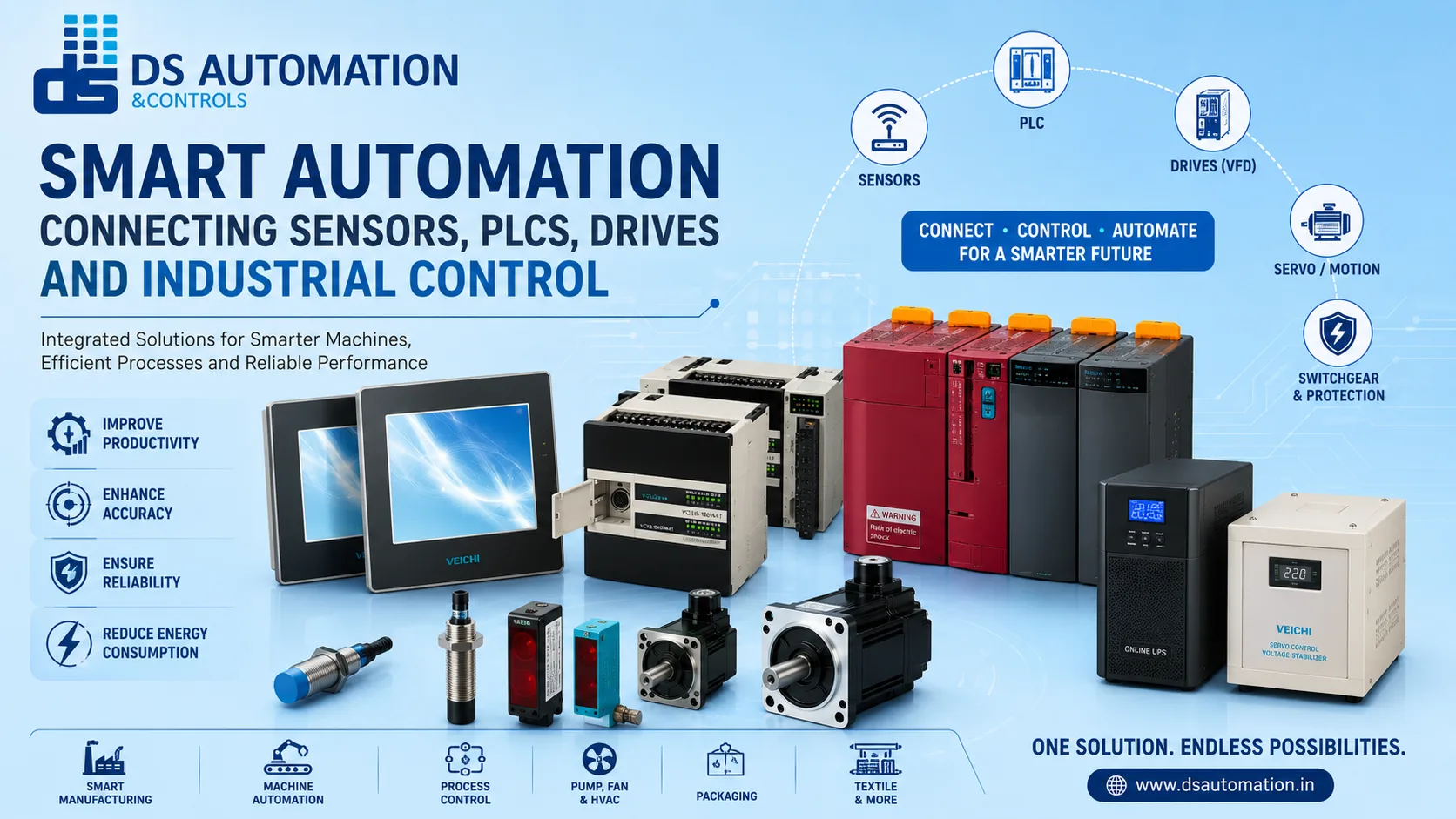
26 Aug Smart Automation Connecting Sensors PLCs Drives and Industrial Control
Modern industrial automation systems require reliable control, communication and monitoring.. A PLC receives information from sensors and processes programmed conditions before sending output signals to VFDs, servo drives, motors or other actuators.
When selecting a PLC, businesses should consider the number of I/O points, processing requirements and communication protocols. Expandability, programming environment and future machine requirements should also be considered.
Understanding Modern Automation Systems
An industrial automation system uses control technologies, electrical equipment, software, and machines to perform industrial processes with limited manual intervention.
A typical system can follow this sequence
Sensors → PLC → VFD or Servo Drive → Motor → Machine
An HMI can give operators a visual interface to check the status of a machine, make changes to settings, view alarms and control operations. That connectivity means that the components can work together, instead of as isolated devices.
Sensors Provide the Information
Sensors are often the first point of interaction between a machine and its operating environment. They detect physical conditions and send signals to the control system.
Common industrial sensors include
- Proximity sensors
- Inductive proximity sensors
- Photoelectric sensors
- Temperature sensors
- Pressure sensors
- Flow sensors
- Level sensors
A proximity sensor, for example, can detect whether a metal component has reached a particular position. A photoelectric sensor can detect products moving along a conveyor.
Temperature and pressure sensors can monitor important process conditions. When these devices are connected to a PLC , the data they collect is used in an automated decision making process. For example a sensor can sense the product at the end of a conveyor and the PLC can take the signal and tell the motor to stop.
After the next operation the controller may start the conveyor again. This simple interaction shows how automation can coordinate individual devices to behave as a system.
PLCs Act as the Control Brain
A Programmable Logic Controller, or PLC, is a central component in many industrial control systems. It receives signals from sensors, processes programmed logic, and sends commands to output devices. PLCs can control motors, drives, valves, contactors, relays, and other industrial equipment.
A typical machine-control sequence may work as follows
- A sensor detects an object.
- The PLC receives the input.
- The PLC evaluates the programmed conditions.
- The controller sends an output signal.
- A VFD, servo drive, motor, or actuator performs the required action.
DS Automation offers Fuji SPH PLC solutions and Veichi VC1 Series PLC products for industrial control applications. When selecting a PLC, businesses should consider the number of inputs and outputs, processing requirements, communication protocols, expandability, programming environment and future machine needs.
VFDs Improve Motor Control
Variable Frequency Drives, commonly called VFDs, are widely used in industrial motor applications. They allow motor speed and torque to be controlled by adjusting the frequency and voltage supplied to an AC motor.
VFDs are commonly used for
- Pumps
- Fans
- Conveyors
- Compressors
- HVAC equipment
- Packaging machines
- Textile machinery
- Material-handling systems
Consider a conveyor where the production speed changes throughout the day. Instead of operating the motor continuously at one fixed speed, a VFD can adjust motor speed according to the process requirement.
The PLC can receive information from sensors and send a command to the VFD. The VFD then adjusts motor operation.
Fuji Electric Drive Solutions
DS Automation provides a range of Fuji Electric FRENIC drives, including
- FRENIC MINI
- FRENIC ACE
- FRENIC MEGA
- FRENIC VG
- FRENIC AQUA
- FVR NEW MICRO
- NEW MINI LIFT
The company also offers Veichi AC310 Series and Veichi AC10 Series drives.
Different drive series are designed for different application requirements, so factors such as motor capacity, load type, overload requirements, operating environment, and control method should be considered before selection.
Control Panels Connect the Components
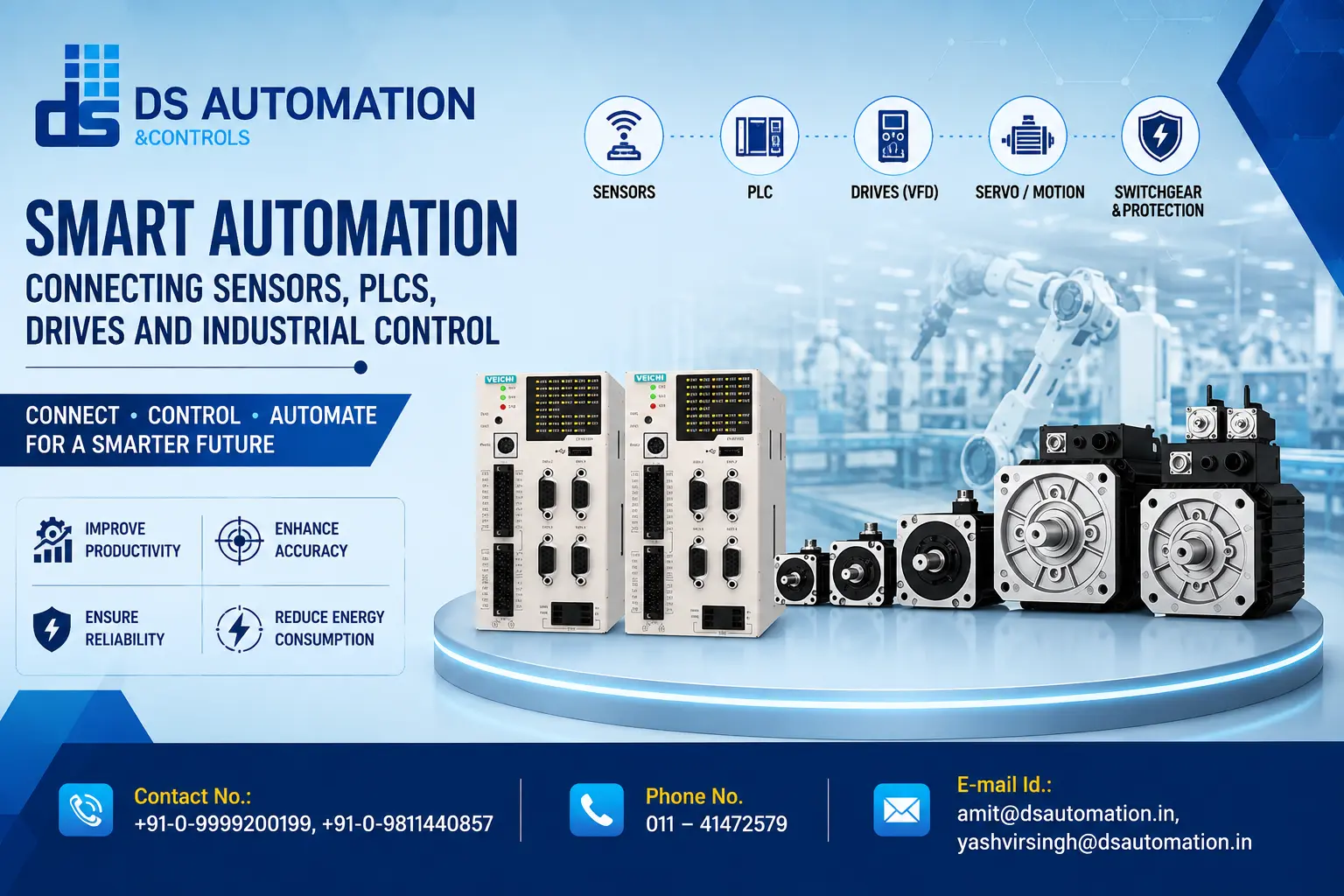
A control panel provides a centralized location for electrical and control equipment. It could contain PLCs, VFDs, HMIs, breakers, contactors, relays, power supplies, terminal blocks and communication equipment. A well arranged control panel makes it easier to operate, inspect and maintain the arrangement of components. So a machine panel could have a Fuji PLC , a VFD to control motors , circuit breakers for protection , contactors to switch , and an HMI for the operator to interface.
Control panels can be designed to suit the needs of a specific machine. The design of a panel should consider the number of I/O points, motor loads, communication requirements, environmental conditions and future expansion requirements.
Servo and Motion Control for Precision
Some applications require more than basic motor-speed control. Machines that require accurate positioning, rapid acceleration, synchronization, or repeatable movement may benefit from servo and motion-control technology.
Servo systems are commonly used in
- Packaging machinery
- CNC equipment
- Robotics
- Printing machines
- Pick-and-place systems
- Textile machinery
- Precision manufacturing
DS Automation offers a range of Fuji and Veichi motion-control products.
Its portfolio includes Fuji ALPHA 7, Fuji ALPHA 5 Smart, Fuji V9 Series, Fuji MONITOUCH TECHNOSHOT Smart, Veichi SD710 Servo Drive, Veichi SD700 High Performance Servo System, Veichi V7E Series Servo Motor, Veichi VM7 Series Servo Motor, and Veichi V5-MC104 Motion Controller.
These products can be selected according to the required positioning accuracy, motor capacity, speed, torque, load characteristics, and communication requirements.
Switchgear Protects Industrial Systems
Reliable control requires reliable electrical protection. Switchgear helps protect electrical circuits and equipment while providing safe switching and control.
Important switchgear products include
- MCCBs
- MCBs
- Magnetic contactors
- Motor starters
- Thermal overload relays
- Industrial control relays
- Pushbuttons
- Selector switches
- Pilot lights
- Time-delay relays
DS Automation offers Fuji Electric MCCBs, MCBs, magnetic contactors and starters, manual motor starters, industrial control relays, pushbuttons, selector switches, pilot lights, and time-delay relays.
MCCBs and MCBs are for protection against electrical faults and overloads while contactors and starters are primarily used for motor switching and control. A well-organized and protected industrial electrical system is achieved by integrating appropriate switchgear with control equipment.
UPS and Voltage Stabilizers Support Power Reliability
Power quality is an important aspect of modern systems. Electrical disturbances can affect PLCs, HMIs, industrial computers, instrumentation and communication equipment. A UPS can also provide backup power in case of an interruption, while a voltage stabilizer can help you maintain a more stable output if the incoming supply varies. DS Automation provides Fuji Electric power protection and conditioning solutions, which include
- Minivet Line Interactive UPS
- Finch PW
- Finch RT
- Finch PG
- Falcon 8500
- Falcon X5
- Falcon X7
- UPS 7000HXi
- Falcon 7000M
- Servo Control Voltage Stabilizers
- Isolation Transformers
- Ultra Isolation Transformers
- K-Rated Transformers
The right solution depends on load capacity, voltage conditions, phase configuration, backup requirements, and the sensitivity of connected equipment.
Creating a Connected Automation Environment
The biggest advantage of a modern automation system is the ability to connect different technologies into one coordinated system.
Imagine an automated production line.
Sensors for product and machine condition detection. The PLC receives the signals and decides what to do based on the logic programd into it . The VFD controls the motor speed. Servo systems provide very accurate motion. The control panel contains and organizes the electrical equipment.
Switchgear is for electrical protection. An HMI allows operators to view the status of the machine and to change operating parameters. Critical control equipment can be further protected by UPS and voltage conditioning equipment. The result is a cohesive industrial environment where
Detection → Processing → Control → Movement → Protection → Monitoring
work together as one coordinated process.
Benefits of Smart Industrial Automation
A well-designed automation system can provide several advantages for industrial businesses.
Higher Productivity
Automated systems can perform repetitive operations consistently and efficiently, helping businesses improve production output.
Better Process Control
Sensors and PLCs provide real-time information that can be used to control machine conditions more accurately.
Reduced Manual Intervention
Machines can automatically respond to programmed conditions, reducing the need for constant manual operation.
Improved Consistency
Automated sequences can help maintain consistent machine operation and production parameters.
Better Equipment Monitoring
HMI systems and connected controllers allow operators to monitor important machine conditions and respond to alarms.
Flexible Motor Control
VFDs and servo systems provide greater control over motor speed, torque, and movement.
Choosing the Right Products
Every industrial application has different requirements. Before selecting products, businesses should evaluate
- Machine type
- Motor capacity
- Load characteristics
- Required speed and accuracy
- Number of sensors and I/O points
- Communication requirements
- Electrical protection
- Environmental conditions
- Power-quality requirements
- Future expansion
Selecting components individually without considering system compatibility can create unnecessary problems. A complete engineering approach should consider how every component will communicate and operate with the rest of the system.
Why DS Automation
DS Automation provides industrial products covering multiple areas of electrical control.
Its portfolio includes Fuji Electric and Veichi products for
- Industrial drives
- PLCs
- HMIs
- Servo and motion control
- Instrumentation
- Switchgear
- UPS
- Voltage stabilization
- Power conditioning
The combination of products allows customers to address different parts of an industrial control system through one supplier.
For product information and industrial solutions, customers can visit www.dsautomation.in and explore the available product categories and technologies.
Conclusion
A properly integrated automation system allows sensors, PLCs, VFDs, servo drives, HMI systems and electrical protection equipment to work together as a coordinated industrial solution.
VFDs are used to control motor speed and servo systems are used for precise motion. Control panels provide protection by assembling electrical components and switchgear. UPS systems and voltage stabilizers improve the degree of reliability of critical control equipment. When properly integrated, these technologies will allow industries to develop systems for better productivity, process control, reliability and operational efficiency. DS Automation is a leading distributor for Fuji Electric, Veichi, offering drives, PLC, HMI, motion control, instrumentation, switchgear, UPS and power conditioning solutions.
For businesses looking to develop smarter and more connected production environments, choosing the right automation technologies is an important step toward building a more efficient and reliable industrial operation.

No Comments